
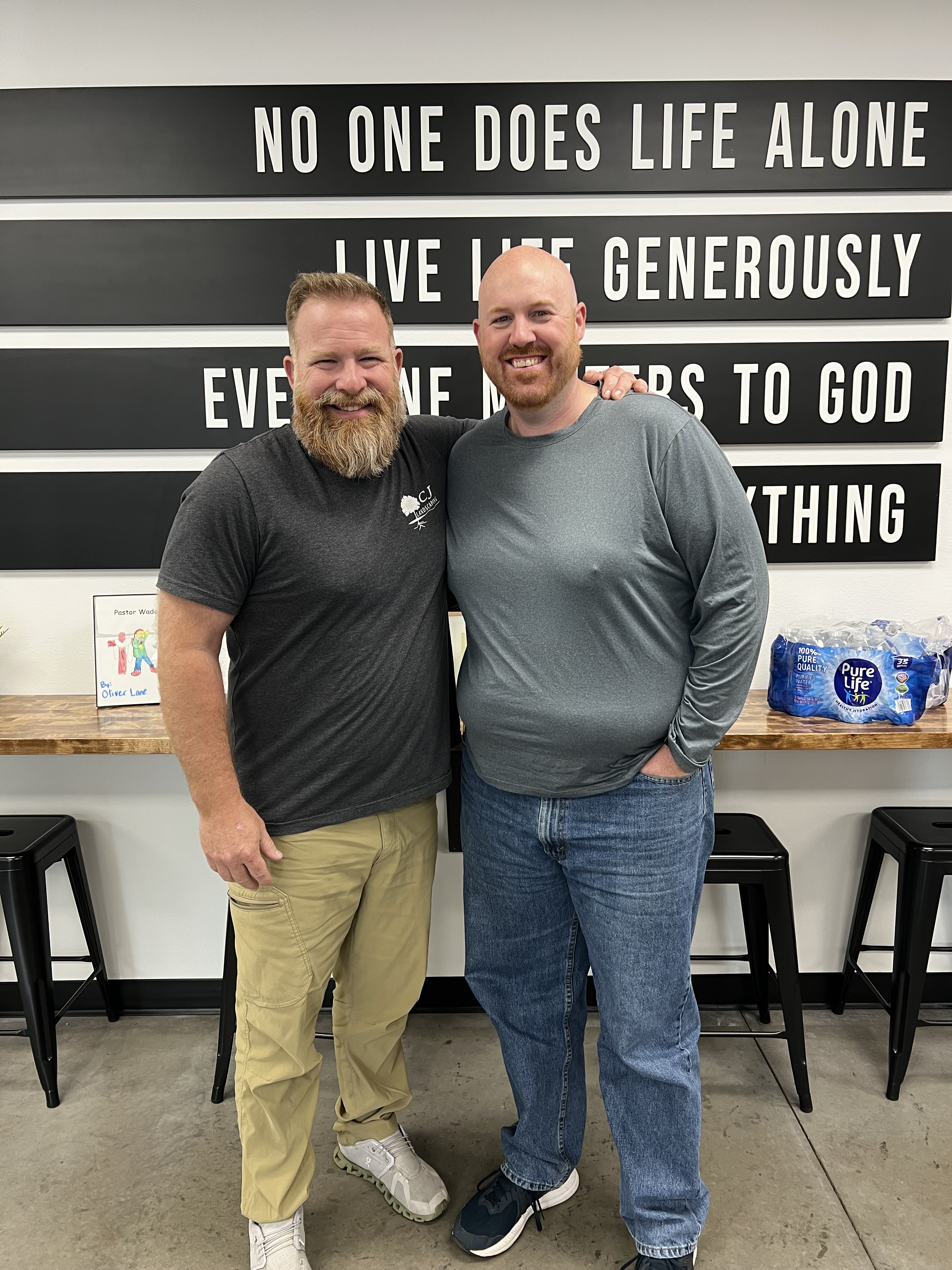
Wade Bishop, pastor at Element Church in Hayward WI, was my first meeting with a ministry leader that I didn’t know. I had reached out to a couple of well-connected friends and asked for the names of pastors of churches in small towns that were using some innovative, creative, or unique ministry ideas. So, I took the 4 1/2 hour drive to the town of Hayward, population approx. 4000, to meet with Wade.
Wade is an energetic, enthusiastic guy that became a church planting pastor somewhat reluctantly. He said that he had always worked with his hands, doing things like carpentry, and he was content to do that until God put some pieces in place that eventually led to Element Church today, an open and inviting new building situated on the edge of town, immediately next to the local schools.
Wade shared with me the now-familiar theme of clarity of vision – he knew what the church needed to be and what it needed to do, and he strongly and consistently leads in that direction. In the midst of that, he talked about emphasizing the why behind the what – it isn’t just asking what do we need to do, by why do we need to do it?
That’s an important question to ask, and one we have talked about at my church for years. I like to say that we love tradition, as long as the tradition is still serving to help us meet the goals and the vision that God has called us to. It’s easy to fall into the habits, the routines of consistent behavior, whether we’re talking about church activities, our jobs, or aspects of our daily lives. But we need to consistently ask ourselves “why”.
“Why am I doing this?”
“Is this what is best?”
“Does this help me to accomplish what I want to accomplish?”
“Is this still beneficial to me?”
It reminds me of an analogy I’ve heard. In the past, space shuttles were launched using rocket boosters – long, skinny rockets filled with fuel. The story goes that the rockets would have been fatter, but they had to be built and transported to the launch site on trains, which had to go through mountain tunnels. Train tracks are a standard 4’ 8.5” wide, and the tunnels were made to fit trains that run on those tracks. That track size was set by the English because that was the size of tramways that preceded the railroads. The tramways were that size because they used some of the same equipment to build them that they used to build wagons. The wagons were that size because, for centuries, the roads and the ruts in the roads around England and much of Europe were that size. And who built those roads? The Romans, over 2000 years ago. So, the size and shape of modern rockets were defined, in part, by of the size the Romans decided to build their roads.
The analogy might be a little bit of an oversimplification, but it highlights a couple of ideas – we can, accidentally, continue doing things for a really long time without knowing where those patterns and habits started, but I think it also shows that sometimes we can continue what has worked in the past because it still works for us. To take that idea one more step forward, today’s rockets from companies like SpaceX look very different and do not conform to the same size and shape as those older rockets for the space shuttles. What was done in the recent past was fine, but for newer technology and goals they built newer designs.
Being willing to step back and ask, “why”, is an important part of our lives. Sometimes the answer leads us to continue as we have. Other times it causes us to shift directions. Either way, if we want to be faithful to our calling as believers, its important to take the time to seek God’s direction.
 Driven