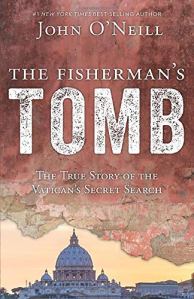
“The Fisherman’s Tomb” – John O’Neill

When I was in junior high I had the opportunity to take one of the best trips of my life. My dad, my grandpa and I jumped in the car and drove to upstate New York where we spent a few days searching old library records and talking to people while we researched our family genealogy. After a lot of microfilm and census records, we ended up driving through little communities in the foothills of the Appalachians looking for certain landmarks related to our family history, leading us into the yard of a rural house. 

We were looking for was a small cemetery that we couldn’t seem to find. As we pulled into the driveway, the owner came out to greet us (and probably to figure out who the strange people with a Minnesota license plate were at his house). We asked if he could direct us to the cemetery, and his response wasn’t what we expected.

“Oh, sure. It’s in the back yard.”

Immediately behind his house, in an overgrown clearing bordered by woods, we found the cemetery (and my dad, grandpa and I all agreed we wouldn’t want to live in a house with a cemetery as a backyard). The most recent headstone we saw was over 100 years old. After a good amount of searching, we finally found a gravestone with the same last name as our ancestor, dated in the mid-19th century.

All of that made me think about what we do to be remembered. Here was an ancestor of mine from 150 years before me, and I can still know her name, who her family was, when she was born, and when she died. I couldn’t really learn anything substantive about her-what kind of food did she like? Was she outgoing or quiet? What was her life’s greatest achievement? This was all made more real when my grandpa passed away from cancer shortly after that trip. How would he be remembered? Now, 20 years later, I’m describing my grandpa to my little girls, telling them how much their Great Grandpa Warren would have loved them.

The more historically important (or rich) a person is, the more that is done to remember them. But time marches on, and much is lost-I sometimes wonder if I would still be able to find that little cemetery in the backyard today.

Sometimes, however, the past can be recovered and learned from. That is the theme behind the amazing story in the book The Fisherman’s Tomb. The book recounts the decades-long archeological and historical search for the apostle Peter’s tomb beneath the Vatican. Peter’s tomb, which had been hidden from the Roman’s in the first and second centuries, had been lost for the better part of 2000 years, until a series of event over the span of decades led to the archeological excavation of the Necropolis, an ancient cemetery that St Peter’s Basilica in the Vatican had been built over, and the eventual recovery and identification of Peter’s remains.

The story revolves around popes, a series of Vatican officials fighting over political power, a ground-breaking woman that led the archeology, and a rich American oil tycoon that secretly financed the entire project. While the book is not the most well-written book you will every read, the story contained in it is one that is most certainly interesting and highly-engaging.

For me, a story like this raises a lot of questions: how do we remember great men and women of the past? Where is the balance between honoring a great leader of the church like Peter and not making too much of a mere human that God used in mighty ways? What do we make of building huge, ornate structures that point to the glory of God, but also cost extraordinary amounts of money, time and effort?

Some day I hope to visit the Vatican, and specifically the Necropolis. It takes a lot of planning ahead of time, but to be that surrounded by history seems staggering, especially for someone that lives in a state that is newer than almost anything found in the entire city!

I’m not Catholic (not even close), but I respect and appreciate the history and tradition of the Catholic church. This story helps remind us that there is a lot to be discovered, and learned, from history. The tenaciousness of those that pursued this hunt for the truth over the span of decades is admirable. I hope that every pursuit of truth is just as dogged.

Don’t be like “Attack of the Clones”

It’s amazing how our attitude affects a situation. We can go into something truly fantastic and be completely disappointed, or we can go into something absolutely awful and be pleasantly surprised, all based on our initial expectations and attitude.

Take the Star Wars movies for example. The original 3 were spectacular. Episodes 1-3 have some varied opinions attached to them. The most recent trilogy is widely criticized. Why? Because the 6 followup movies didn’t meet the expectations of the biggest fans of the first 3. None of the 6 sequels was bad (well…episode 2 isn’t great…), but when you show up to The Rise of Skywalker and expect it to be even better than Return of the Jedi, you are bound to be disappointed.

Now, to begin with, our quarantines, stay-at-home orders, and self-isolation are not good (they’re way worse than episode 2!). We miss connecting with friends and family members, we are missing out on trips and activities, and we are limited in our actions and activities. Its clear to me that some of my friends are already starting to go stir-crazy, and we aren’t half way through it yet!

But, if we choose to have a positive attitude we can see some good things come from it. Being at home with family gives us a chance at more quality time together. Having more time to fill allows us to get done with some projects, do some reading, and learn something new. Being away from certain things and certain people build a better sense of priorities and what is most important in our lives.

There are certain parts of our society that will be permanently changed by this pandemic. And that is a good thing. I think there will be even more people that work virtually from home. I think better plans will be put into place to help those in need during future crisis. And, I think the way we do church will be fundamentally changed forever. I also think the next wave of creators, inventors, entrepreneurs, and future leaders are hard at work right now, and we will see the fruits of their labors in the coming months and years. This event is a tragedy on many fronts, but there will be good in it as well.

The last part of the book of Genesis recounts the story of Joseph. Either Joseph had the worst set of brothers in the world, or he was a truly horrible brat of a little brother (or a combination of both), because the 10-on-1 sibling rivalry was so bad that the older brothers planned to kill him, and only the promise of making a few bucks by selling him as a slave changed their minds. This started Joseph down an up and (mostly) down path for the next several years, until he had risen to become the second most powerful man in the most powerful nation on the planet.

Joseph didn’t have a pandemic to deal with; he had a major, region-wide drought and famine. He had set the nation of Egypt to be secure, but outside of Egypt people were starving and dying. Joseph’s brothers made their way to Egypt to attempt to negotiate a trade in order to get some food for their very large family, but little did they know that the high official that they would have to deal with was the brother that they had sold to get rid of.

But Joseph had a different perspective: nothing happens outside of the power of God, and even evil can be used to bring about something good.

As for you, you meant evil against me, but God meant it for good…

-Genesis 50:20

We will get through this. There will be a day when we return to our daily lives, when our kids go back to school, when we go out to lunch at a restaurant, gather together again on Sunday mornings, and take our kids to play in the parks.

In the mean time, keep a positive attitude; look for the blessings, little and big, that God is giving to us even in these difficult times; and remember that He is alway in control.

“The Great Divorce” – C.S. Lewis

There are only two kinds of people in the end: those who say to God, “Thy will be done,” and those to whom God says, in the end, “Thy will be done.” All that are in Hell, choose it. No soul that seriously and constantly desires joy will ever miss it. 

Those who seek find. 

To those who knock it is opened.

C.S. Lewis, The Great Divorce

I remember, as a child, trying to get my brain around the idea of heaven. I long assumed that the description I heard at church was wrong, because it sounded painfully boring: just a lot of standing around, listening and singing. Like a really long Sunday night church service-mostly like Sunday morning, but better music and I didn’t have to dress up.

I remember the picture I developed in my head. It was basically a boy’s dream bedroom: super comfy bed, with a TV at the foot of the bed with a Nintendo and all the games I wanted. There was a mini fridge filled with Mountain Dew on the side, along with all the Doritos I could want. Above my bed hung my beloved Shaquille O’Neal Orland Magic poster. And, for some reason, I had a lamp by my bed, because I guess I thought that was important…?

The problem was, even that struck me as something that I would (eventually, after a lot of Dew, Doritos and Super Mario Bros) get bored with.

For a long time I struggled coming up with a concrete picture of heaven. I could talk about concepts and ideas, but I wanted pictures in my head. C.S. Lewis gave me 2 great ones: The Chronicles of Narnia: The Last Battle, and The Great Divorce.

“What are we born for?”

“For infinite happiness,” said the Spirit. “You can step out into it at any moment.”

C.S. Lewis, The Great Divorce

The Great Divorce is the story of a bus filled with inhabitants of hell going on a visit to the outskirts of heaven and interacting with some of its inhabitants. Hell is displayed as a very dreary and empty city—the inhabitants have a natural dislike for each other, so they keep building and moving apart so they can live alone in their misery while pretending to be civil. Heaven, on the other hand, is bright and natural. An interesting twist is that the inhabitants of hell find heaven to be “too much.” They are, in essence, ghosts: they aren’t really real, they’re almost not even there. Heaven, by comparison, is so real that even the blades of grass feel sharp to the ghosts.

Just to be clear, both this book and The Last Battle are examples of allegory. They are stories meant to emphasize and bring out ideas, but they can be overextended. I do not believe and will not accept that the Bible teaches that there is an opportunity for inhabitants of hell to visit heaven and choose to stay there, but that is the offer made in The Great Divorce. The shocking revelation is that none of them want to be there.

Earth, I think, will not be found by anyone to be in the end a very distinct place. I think earth, if chosen instead of Heaven, will turn out to have been, all along, only a region in hell: and earth, if put second to Heaven, to you have been from the beginning a part of Heaven itself.

C.S. Lewis, The Great Divorce

The crux of the story is the idea of choice. We all choose what we will do: what we will have for supper, who we will marry, whether or not we will eat the whole package of Oreos.

In the story, the opening quote in this post is key-God gave people a choice: either we say to God, “Thy will be done,” or we demand that God say to us, “thy will be done.” So, those who are in hell chose it, on purpose, and no amount of talk or encouragement will make them choose differently.

Throughout the story Lewis introduces us to different “ghosts” and to different “spirits” from heaven that visit them and try to get them to stay. In those conversations I find a lot of myself and my own struggles revealed: selfishness, thinking too highly of myself, self-reliance. All of those things keep us from submitting to God and grabbing hold of the joy that is offered by Him.

Once you were a child. Once you knew what inquiry was for. There was a time when you asked questions because you wanted answers, and were glad when you had found them.

Become that child again: even now.

C.S. Lewis, The Great Divorce

There are some stories that just resonate with a person. This is one for me. It’s short, but it’s powerful and speaks to something inside all of us: many (all?) of us struggle at times with the concept of what heaven will be. But we cannot grasp the glory, the truth, the weight of heaven, especially in contrast to the emptiness, the loneliness, and the despair of hell.

Even as a Calvinist, I end with this: I pray that we all choose the infinite happiness.

They say of some temporal suffering, “No future bliss can make up for it,” not knowing that Heaven, once attained, will work backwards and turn even that agony into a glory. And of some sinful pleasure they say “Let me have but this and I’ll take the consequences”: little dreaming how damnation will spread back and back into their past and contaminate the pleasure of the sin. Both processes begin even before death. The good man’s past begins to change so that his forgiven sins and remembered sorrows take on the quality of Heaven: the bad man’s past already conforms to his badness and is filled only with dreariness. And that is why…the Blessed will say “We have never lived anywhere except in Heaven, : and the Lost, “We were always in Hell.”

And both will speak truly.”

C.S. Lewis, The Great Divorce

No one expects the unexpected

Difficult and unexpected situations tend to bring out some unexpected things.

  • We don’t realize how important something is until it’s gone. Like toilet paper or deodorant.
  • We don’t fully appreciate how much teachers do, until we start teaching our own kids at home.
  • We aren’t grateful enough for simple opportunities to gather together, shake hands, give a hug, and just connect with other people, until we can’t.

We find lots of challenges in having to stay home. But, when we look for them, we can find plenty of things that we can be thankful for too. 

  • We get to spend more time with family—yes, that can be a challenge sometimes too. If you are struggling, try a mantra that my family uses: “I love my family all the stinking time.” Just keep repeating it. It might work. Eventually.
  • A lot of people are getting out and walking more. That’s a good thing-its healthy, it brings us closer to God’s creation, and it gives us a chance to see people (from a socially-appropriate distance) that we otherwise wouldn’t.
  • We have the opportunity to gain appreciation for those things that we have lost or are more difficult.

There’s also one more side of this too. Any time there is a break in routine and schedule, it is a chance for evaluation and change. Maybe there are things happening in your life that you don’t like or, after some reflection, you realize could be improved. This is a chance to change something for the better.

I’ve spent a lot of time over the last couple of weeks absorbing what various other ministry leaders around the nation are saying. Current events are having an interesting effect where they are placing everyone on an equal playing field. Whether you’re part of a multi-site megachurch or a little country church with a couple of dozen members, we’re all at the same place: we don’t know exactly what to do. So we move forward the best we can with what we have.

That is going to have long-term ramifications. There are going to be a lot of changes to churches when everything is said and done. Our pastors, our members, and the world as a whole is seeing everything in a new light, and it will affect how we do ministry and church for the long term. The reason for that is simple: a lot of churches have taken a lot of things for granted, and this break is bringing to light what is really important and valuable.

The same can be true for you. Take time to reflect on what is important, what is valuable, what has real meaning in your life, and lean into that. The outside things, the distractions and the less valuable things that take time away from the better things—eliminate them.

Use this time to better yourself. Walk more. Be self-reflective. Spend more time in God’s Word. Maybe learn something: grab a book or look at some of the free online learning resources available now. Disruptions aren’t always bad. Let something good come out of this one.

“Faith For Exiles: 5 Ways For A New Generation to Follow Jesus in Digital Babylon ” – David Kinnaman & Mark Matlock

Too many of our ministry efforts prepare people for a world that doesn’t exist, under cutting our witness and passing flimsy faith to the next generation. Because, honestly, we are scared.

David Kinnaman & Mark Matlock

I love to travel. Seeing new things, experiencing different settings and ways of doing things…its exciting! When I was younger I took traveling for granted—my family did it quite a bit—but as I have gotten older I have increasingly seen how travel shapes a person. When we get out of our local “bubble” and see different perspectives, we gain a broader view of the world.

The great Mark Twain wrote a book by the name of The Innocents Abroad on his travels around the Mediterranean coast. In it he wrote, “Broad, wholesome, charitable views of men and things can not be acquired by vegetating in one little corner of the earth all one’s lifetime.”

It’s easy to allow ourselves to be rooted in one place and to become accustomed to doing things a certain way, and that’s ok to a point. However, we must understand how that can affect us. For example, I grew up in a rural farm community, moved into a downtown metro area for a decade, then moved back to a rural farm community. I have friends in the metro and rural areas, and some of them have no concept of how different they can be from each other. There is just an inherent different way of thinking. And, the farther apart we are, the more different we become.

That distance is more than geographical too. There are generational differences that simulate thousands of mile of distance and the thinking and ideas that go with it. Todays Millennials (and Gen Z behind them) are dramatically different than the generations that came before. Its easy to criticize over these differences, and some criticisms are always warranted, but the reality of those differences will remain.

Our conservative evangelical churches, for a long time, stubbornly remained in a singular way of thinking. I’m sure it changed small-bit by small-bit from time to time, but largely we remained…consistent. Over the last couple of decades, however, things have changed, and a new openness and desire to reach out seems to have gripped us. There are always struggles that go along with change, but it has pushed these churches forward in growth while other churches have dwindled.

We now face a new challenge in engaging with Millenials during a time that there is rapid growth in the number of people that identify as “Religiously Unaffiliated”. These individuals have either never had a significant church experience, or they have left the church behind. We now have the challenge of reaching out to these individuals, and doing so without the power of being the dominant cultural belief system in our nation.

Faith For Exiles was written by David Kinnaman and Mark Matlock after years of research for Barna, a Christian research organization. They specifically looked at trends that led to individuals leaving the church compared to those that stuck around and grew in their faith, and they identified 5 practices of those that stayed: experience intimacy with Jesus, accurately discern culture, form deep and meaningful relationships in the church, receive vocational discipleship, and engage with a counter-cultural mission.

Relationships are meaningful when we are devoted to fellow believers we want to be around and become.

David Kinnaman & Mark Matlock

My take-away from all of that is this: in churches, we tend to say a lot of things like “we value relationships” and “we are founded on the Bible”, but we don’t tend to be as honest about how difficult what we say really is. “We value relationships,” but we only spend a few minutes a week together. “We are founded on the Bible” but we pick and choose what we like and don’t like, and we add our interpretation as equal to the words of the Bible.

That may sound harsh, but that is just the reality of what it means to try and live out our faith. It is hard. It takes honesty, humility, and authenticity. But, when we approach that reality from a broader perspective that we gain when we seek to understand something or someone outside of our “bubble” or comfort zone, then we can start making some progress with it.

So…find a way to open your perspective. See things from a different angle. Then, use that to help you better connect with those around you.

We have to look for ways to offer deep explorations of Christ and not just go through the motions of church. As church leaders, making Jesus our true North means prioritizing these eager followers who are so passionate for Jesus – not running a spiritual club.

David Kinnaman & Mark Matlock

Getting out while not going out

So…my last post went in a different direction than I had intended, so I’m going to try this again…

A lot is changing around us right now. And we don’t like change. We all like knowing what to expect, and some of us really like knowing what to expect. It’s probably a control thing-I know it is with me. I like to have control, so I plan. Then I make backup plans, and backup plans for the backup plans. I’m always talking about the “what if”s. I want options and I want control. That’s why the toilet paper thing annoys me: I don’t need any toilet paper right now, but if I did need some I would have a difficult time getting it, and that’s a problem!

We don’t know for sure what the coming weeks will be like. That will be annoying to some, and it will be downright terrifying to others, but we are all reacting to it. I saw an interesting article recently that pointed out that this virus is causing all of us to go through the 5 stages of grief: we begin in denial – “this isn’t really a big deal.” We move on to anger – “I hate that this is so disruptive!” Next is bargaining – “if I follow these rules then I can get away with some other stuff.” Then the depression hits, which is filled with fear and is a place that I think a lot of people will stall out at. The final stage is acceptance, a stage of grief that can be difficult to get to.

I think a lot of us have probably dealt with grieving people that we know got stuck in one of these stages: they deny that the loss happened, or they are perpetually angry moving forward, or they are overwhelmed with sadness and depression. None of those are places we want to remain.

The same is true of life now. We can’t deny the existence of the Coronavirus. Being angry at a virus isn’t helpful, and while it may feel good and right to be angry at the government it probably won’t get us anywhere, and settling in to a place of depression and fear is a punishment that might be worse than the virus itself.

As followers of Christ, we are called to a certain way of life. This way of life doesn’t always look the same from person to person or time period to time period, but there are some universal characteristics to it. One of those characteristics is a bold engagement with the world. Paul tells Timothy:

…for God gave us a spirit not of fear but of power and love and self-control.

2 Timothy 1:7

We are not to approach life with fear. If we live in fear, we are not living out our belief that God is in control and that He is taking care of us. We are lacking faith.

I want to jump in quick here and say that this doesn’t mean that we needlessly put ourselves or others at risk. This isn’t a justification for living in the “denial” stage. We don’t pretend that nothing is happening and spread the disease more, and we don’t just put ourselves and our families at risk for no reason.

It does, however, mean that we are sometimes called to take risks in order to advance the work of God. Think about the story of the Good Samaritan. This man walking on a dangerous road known for ambushes by bandits, comes upon a man that has been ambushed by bandits and was left near death. Who is to say that the bandits aren’t still there, waiting for someone to stop and help and then getting them too? But the Samaritan stopped anyway, and he slowed himself down (opening himself to more risk) in order to help someone in need.

Our situation today is an opportunity for the church. We have a calling on us to love God and love our neighbor, and we have, and will have, neighbors that need a great deal of love.

So what can we do? Here are some ideas:

  • Check in on those who are vulnerable: the sick, the elderly, and those that are on their own. The Bible is filled with calls to help the needy; that certainly hasn’t changed for us today.
  • Connect with your neighbors. Go outside, keep a little distance, and have a conversation. Talk across a fence or an alley. Ask how they are doing, if there’s anything they need, and pray for them.
  • Connect with your community. Find a way to talk with your neighborhood or town as a whole. I’ve already seen calls to write encouraging messages on the sidewalks and post hearts in windows to show solidarity. It’s also good to support your community by supporting local businesses. Right now in Minnesota all restaurants are to-go only and will be for several more weeks. Go order supper to go, not because you need it but because you want to support your community by supporting its businesses. And find other ways too. Be creative and keep connecting with your community.
  • Help where you can. Maybe someone is struggling financially; buy them some groceries or a meal. Make a grocery run for someone in quarantine. Do some yard work for someone who isn’t feeling well. There is always something we can do.
  • Pray. This is an opportunity to grow in our faith by strengthening our prayer life. Pray for our nation, our state, our area, our town, our neighbors, our churches, our families. Pray that individuals would have peace, leaders would have wisdom, health care workers would be protected and strengthened, and families would be safe. And, most of all, pray that God would be glorified and the Gospel proclaimed far and wide.

Points if you can pronounce "Habakkuk"

Over the last few days or so, I’ve begun to get use to a feeling of surrealness. 

I went grocery shopping last week. It wasn’t that the store was empty-there was plenty of food. But it certainly was more empty than I’ve ever seen a grocery store. It reminded me of shopping for groceries in other countries, where your shopping list is more like a list of goals; you get what is available.

Then, Friday, my buddy Luke and I turned our church sanctuary into a makeshift video studio, setting the stage for the strangest Sunday morning service I have every experienced. There were 6 of us in the building, and 2 of those 6 were my kids. Instead of preaching to a room full of people from behind a pulpit, I preached to a camera with a teleprompter.

And that feeling of surrealness just carries on: I walk down Maine St and its empty. I grab some takeout from a restaurant and have to wait outside the door if there is someone inside already. And, wherever I go, I have a half gallon bottle of hand sanitizer with me that I stole from the church (don’t tell anyone!).

And, the thing is, I’m not paranoid. I’m not scared of what is happening, I just want to be responsible and try to help “flatten the curve” by “social distancing” and all the other lovely “phrases” we’re hearing these days.

While I’m not afraid, I know that a lot of people are and I think we can all understand why, unless you are one of those idiot spring breakers we see on the news (seriously, I saw an interview clip and began to lose hope in the future of our nation). There are some scary stories out there, including stories of men my age, without preexisting conditions and with small kids at home who are dying of this virus. That’s scary, and sad, and sobering, and I pray for those families and others in similar situations.

But we must remember that God is in control, despite the hardships we see and the pain that many are experiencing. Nothing is happening outside of His control. He isn’t absent, He isn’t far off, and He isn’t just smiting the earth. He is here with us, He grieves with us, and He is continuing to call us into His kingdom. This virus is a result of the fall, of our rebellion against God. It is not a symbol of a vindictive, weak or absent God.

Even in a dark time like this, God is at work. He is doing something. You may have seen the clip of Billy Graham that has been circulating the last couple of days from a sermon on Habakkuk, where God says this:

Look among the nations, and see; wonder and be astounded. For I am doing a work in your days that you would not believe if told.

Habakkuk 1:5

God has a habit of exceeding our expectations. Sometimes we see it, sometimes we don’t. But, when we do see it, it is astounding. He has this ability to drive forward His plan through anything and everything the world throws out there. All the evil, all the pain, all the suffering that this world has to offer, and God simply weaves it into what He is doing to advance His kingdom. And He even works it out for the good of His children!

That doesn’t mean He removes the suffering or makes it easy – the Bible, and history, show that God does not often remove His people when times are hard. But He does call His children to a bigger perspective, one that changes how we view struggles and suffering. Whatever we are going through now is just a blip in the perspective of eternity, and that blip is a part of God continuing to establish His kingdom. As Paul writes:

For this light momentary affliction is preparing for us an eternal weight of glory beyond all comparison…

2 Corinthians 4:17

I love that phrase, “light momentary affliction”. It could refer to anything, given the right perspective. Stepping on a Lego could be a “light momentary affliction”. Misplacing your cell phone could be a “light momentary affliction”. Or, suffering great loss, experiencing chronic pain or illness, battling depression or mental illness, or even martyrdom can be a “light momentary affliction” in the greater scope of eternity. And that is the point Paul is making: we need that perspective of eternity, and the hope that comes from having faith in God and His plan.

I really like CS Lewis’ The Great Divorce. It’s a wonderful little novel about residents of hell having a chance to see what heaven is like, and it challenges a lot of assumptions we have about our thinking of sin, heaven and hell. In it, one of his characters says this:

That is what mortals misunderstand. They say of some temporal suffering, ‘No future bliss can make up for it,’ not knowing that Heaven, once attained, will work backwards and turn even that agony into a glory. And of some sinful pleasure they say ‘Let me have but this and I’ll take the consequences’: little dreaming how damnation will spread back and back into their past and contaminate the pleasure of sin. Both processes begin even before death. The good man’s past begins to change so that his forgiven sins and remembered sorrows take on the quality of Heaven: the bad man’s past already conforms to his badness and is filled only with dreariness. And that is why, at the end of all things, when the sun rises here and the twilight turns to blackness down there, the Blessed will say ‘We have never lived anywhere except Heaven,’ and the Lost, ‘We were always in Hell.’ And both will speak truly.

C.S. Lewis, The Great Divorce

Read that again. There’s a lot to get your brain around.

It speaks to our relationship with sin and suffering. We rarely really come to grips with how pervasive sin is in our lives and in the world as a whole. Sin infects everything (I think theres a Coronavirus analogy in that if you want). But, God’s grace, or “blessedness” if you’d like, works the same way. It spreads, it changes us; it is actually fixing us, remaking us, returning us back to what we were created to be and away from the distorted creatures that sin has turned us into.

Grasp that eternal perspective. Latch on to the hope we have in eternity with Jesus. Allow His peace to spread through you and out into a world in need of peace and comfort right now.

"Evangelism As Exiles" – Elliot Clark

So many of us are in love with this present world, yet it seems we’d rather keep the world — or, more accurately, its sinners — at much more than arm’s length. Far too often we’re a happy and hope-filled people as long as our churches are prospering, as long as we have a seat at the cultural and political table. But it’s highly unlikely we’ll invite the world — other races and creeds and lifestyles — around our own kitchen table. We’re of the world but somehow not in it.

Elliot Clark

A growing theme in Christian thinking and writing is the idea of American Christians as cultural exiles, and I completely agree with the idea.

I have a church history class that I teach from time to time. It starts with the Acts church and extends to today. It was somewhere around 2014 when I was teaching an adult Sunday school class the final lesson on the modern church when I ruffled some feathers.

We were discussing the different cultural battles we were seeing; especially the erosion of the nuclear family and marriage (this was before the Supreme Court ruled same-sex marriage as a constitutional right). Several of the comments made by individuals focused on how we had to fight to win the cultural war. That’s when I shook them a little: I told them that it was too late, that we had already lost the war. We had been too disconnected, too elitist, too hypocritical, and our country had moved on without us.

What do I mean by that? Well, we already live in a nation that does not accept traditional Christian morals, and we are fast approaching a time when a majority of Americans won’t identify as Christian, and I think that’s a good thing. In American, around 65% of the country claims to be Christians, but if you define Christian as someone that believes the Bible and tries to live by it, that number is actually somewhere around 5%. That means there is 60% of the nation claiming to follow Christ and misrepresenting him to others. That is what we call a bad thing.

In Evangelism As Exiles, Clark uses the book of 1 Peter and his personal experiences as a missionary to show how believers can embrace a counter-cultural position and use it to bring the Good News to the world. It is going to take work; quite frankly, it’s going to take more work that most Christians are accustomed to putting in. It’s more than just showing up to church on Sundays — it’s being involved in other peoples lives, actually caring about them, and building relationships that point to Christ. It is something that we have to do intentionally, on purpose. In other words, its Christians doing what we always talk about but often neglect.

What it means to be a Christian in America is going to continue to change as time goes on, and I believe it is going to change dramatically in a fairly short time. But our calling as Christians is the same: Love God, Love Others. That isn’t a passive calling, it’s an active calling, one that we need to embrace.

…the greatest hope for our unbelieving neighbors isn’t them coming to us, but God sending us to them. It’s us living on mission in their neighborhoods, and our home becoming a place where they can meet the Savior.

Elliot Clark

Blog: The Return…again…

Don’t call it a comeback, I’ve been here for years…

LL Cool J, Mama Said Knock You Out

Wow…it’s been a long time since my last run at this blog thing.

But, I’m going to give it another go. I’m shooting for a post a week, something short, relevant, encouraging, challenging, and, as always, biblical. Should be easy… (that was a joke)

I’ll also have the occasional post with a quote from someone smarter than me. (that really is pretty easy)

I’ll also also have the occasional book review.

I’m not going to take down my past posts. They’re old, they may eventually get edited or changed as I find some previous thoughts that I no longer like or agree with, but there is some good stuff in there too. Feel free to browse back and see what I thought back in the day.

I hope this will be an encouragement to you. As I like to say, if your life as a Christian is easy, you’re doing it wrong. We need help along the way. This is one way I’m trying to do my part.

To get a sense of where I’m coming from with this whole thing, I’d encourage you to take a look at my first post, written almost a decade ago. In a lot of ways this is the heart of how I view life. I hope the thoughts challenge you as much as they challenge me.

Driven

God bless,

Bart

Do I have to go to church to be saved?

“Do I have to go to church to be a Christian? ‘Cause if I do, then that’s a problem.”

The caller that had apparently picked a random church at a random time and got me on the other end of the line was looking for an answer to a question I have heard numerous times. What do I have to “do” to be a Christian? Do I have to get up early every Sunday and show up at a building in order to be a Christian? Which building should I go to?

Then, on top of all of that, I hear the second part of the issue: “I’ve had bad experiences in churches. People have hurt me. I’ve felt judged and attacked. I don’t want to go through that again. That’s the problem-if I have to go to a church to be a Christian, I’m not sure I want to be one.”

There’s no quick, easy answer to these issues; too often we oversimplify, and in doing so we lose sight of the truth. So lets break this down a little. “Do I have to go to church to be a Christian?” No and yes. No, because being a Christian simply means being a follower of Christ. The Bible says that’s as simple as believing in Jesus Christ as your savior, meaning his death and resurrection are enough for your sins to be forgiven. That’s not complicated. There is nothing we can “do” to become Christians – no amount of good deeds or actions can fix our relationship with God; only Jesus can do that. To think we can “do” something is to believe we are strong enough or good enough to equal the work of Jesus. We don’t “do” anything; we believe.

But, there is a yes to the answer as well. If we do want to follow Jesus, if we do want to be Christians, then we want to be obedient. Throughout the whole of the Bible, gathering together with likeminded believers is so obviously needed that it is assumed. Jesus repeatedly referred to gathering together, continuing to do what their Jewish predecessors had done for centuries. The entire book of Acts is about the establishment and growth of the early church. The books 1 and 2 Timothy and letters written by Paul as he mentors a young church pastor. Most clearly, Hebrews 10:25 says, “let us not neglect our meeting together, as some people do, but encourage one another…” (NLT). Maybe you can be a Christian without attending a church, but you would be doing so while disregarding something so fundamental to the faith that it begs the question as to whether the faith is truly yours.

It’s true that churches can be difficult places to be. There are judgmental people, angry people, and demanding people. We can feel attacked, betrayed, and alienated when we are a part of a church. That’s because churches are filled with sinful, flawed people like you and me. On top of that, when we open ourselves up to others we risk getting hurt. However, we also open up the possibility of having others fill us with the encouragement and support we need to get through the tough times. There is a risk in taking the step of being a part of a church community, but there is also the potential of great reward, both in having others love and support you and finding a place where you can love and support others as well.

If you have been hurt, I’m sorry. That happens too often and it breaks my heart. But don’t give up. Find a church, a group of people who share your faith and are willing to open their doors and their hearts to you. Get involved, take a risk, and see what a loving, supportive community can do for you. Life is too hard to do on your own; find others to share the burden with you. Our community has a number of great churches that would welcome you. If you don’t have a church family, try out a couple of these churches and find one to settle in to. God has some great blessings waiting for you there.