Rewind: Words, words, words

I have always enjoyed reading. When I was a kid, I read all kinds of things, from some terrible Sci-Fi novels to Shakespeare (the title is a Hamlet quote, by the way; Act 2 Scene 2). What I haven’t always enjoyed was reading books that would teach me something. Especially after college, I found it really difficult to pick up any books other than those that would be entertaining or distracting.

A lesson I learned from many older and wiser teachers was this: when we stop reading, we stop learning and growing, and we will never reach the potential God has put in us. So I started reading again, and slowly a desire to continue to read and learn has grown. Recently I put together about a 10 month list of nonfiction books I have read, and it was exciting for me to look back at what God has taught me in that time.

Reading isn’t just about the words, it is a time investment. When you read something for the purpose of learning and personal growth, you are investing time in yourself.  So not only is reading important, reading the right books are important. Every book I pick up and read I have chosen for a very specific reason; a specific topic, a specific author, maybe a recommendation from someone I trust. I have intentionally spread out the material I have read; books published in the last couple of months, books by the early church fathers, leadership teaching, discipleship teaching, history, contemporary issues, etc.

I want to share some of this with anyone interested in investing in themselves. I will be writing posts on some of the books I have been reading. I will compile a list of these posts under the section “Recommended Books.” I hope you read some of these and share your thoughts. Remember, knowledge that isn’t shared is useless.

Loving the Stinky

PigLife often stinks. I mean, literally stinks. If you are with me in Martin County, the pig capitol of the world, you may understand this better than some. I still remember going to basketball practice in high school during winter break. The team would meet in the locker room to get ready, and it was quite an experience. I would walk in after doing whatever I was doing and know I’m not exactly smelling like roses and lilacs. However, I would then have my senses assaulted by the handful of teammates that had just arrived at practice after working in the hog buildings all morning. That’ll wake a guy up before practice!
Stinky people aren’t a lot of fun to be in close quarters with. We often have a negative reaction to them; if they smell, it means they aren’t particularly clean. They’re hygiene isn’t what it should be. We don’t want to be around them.

And in the same region there were shepherds out in the field, keeping watch over their flock by night. And an angel of the Lord appeared to them, and the glory of the Lord shone around them, and they were filled with fear. And the angel said to them, “Fear not, for behold, I bring you good news of great joy that will be for all the people…

-Luke 2:8-10, ESV

When Jesus was born, God could have called up anyone to share the news. And who is the first bunch that He brings to the party? A bunch of shepherds; stinky, dirty, straight-from-the-fields sheep herders. As a friend of mine shared recently, they didn’t exactly have high quality bath facilities up in the pastures. These were guys that you gave a wide berth to when you passed on the street. And these are the first people God wanted to introduce to His son.

It makes me wonder – who are we introducing to God’s son? Are we only approaching those people we think are “clean” enough, “good” enough, “normal” enough, or enough like us? Are we spending time and building relationships just with people that we are comfortable with, or are we opening ourselves t go out of our way to connect with and care about any and all that God puts in our path? Are we looking for out for the needy, both those who are in need of physical things and those who are in need of the care and attention of another human being? We are called to love others, not just the easy people to love but the “stinky” ones as well.

Rewind: It Isn’t That Complicated

We really do some ridiculous stuff sometimes, don’t we? For example, Francis Chan uses an easy analogy that points something that is pretty simple that we all do that really is unquestionably stupid. Imagine you have a teenage daughter, and you tell that daughter to clean her room. If she comes to you an hour later and says, clean“Hey, I went and I memorized what you told me: ‘Go and clean your room!’” are you going to be happy with her? What if she says, “I can now say ‘Go and clean your room’ in Greek!” or “Some friends and I have organized a study to get together weekly to talk about what it would look like if we followed what you said and cleaned our rooms”? While this would lead many lists of most inventive ways to avoid doing chores, this would probably not amuse you as the hypothetical parent.

The thing is, we do the same thing with our not-so-hypothetical Father, and He isn’t amused either. Jesus said it clearly;

If you love me, you will keep my commandments.
-John 14:15 (ESV)

What does this mean? It means that if you love Jesus (aka Christian) you will do what Jesus said. What does it imply? If you do not do what Jesus said, you do not love him (aka not-Christian).

This doesn’t mean that following Christ, keeping his commandments, is easy. The next verse in John is Jesus’ promise to send the Holy Spirit, whom he calls “The Helper” because he’s here to help us, and we most certainly need the help! But we have what we need to follow Christ – we have the help and the words, and it isn’t any more complicated from that point on than doing what Jesus said. Part of that is knowing what Jesus said.

We must know the Bible, understand what it says, study it in depth, and talk about it at church and in small groups. It should become central to our lives and the foundation for everything that we do. However, if we study the Bible but we don’t let it change us, there really isn’t any value in the study. If the Bible isn’t radically changing how we view and interact with the world around us, then we would just as well to study The Hobbit or Crime and Punishment or some Harry Potter novel. At least those wouldn’t make us uncomfortable.

But be doers of the word, and not hearers only, deceiving yourselves.
-James 1:22

Check out Francis Chan in “BASIC: Follow Jesus

Loving Mr. and Mrs. Whatstheirface

I recently set off on a new adventure; after over 10 years of youth ministry, and 9 years working sccas a youth pastor, I have stepped out and taken leadership of a new ministry that is looking to reach out and minister to young adults in and around Fairmont, MN. It’s a big step of faith, but my wife Charmaine and I firmly believe it is the path that God would have us walk down.
In the first couple of months working to start this ministry, one of thing that has stuck out to me is the significance of relationships. This is not a new thing for me: I have pounded the drum for focusing on building strong, healthy relationships for years. But I’ve been reminded of the importance of relationships once again.
Relationships can be hard.
It’s easy to go to church, bump in to Bob and Jane Whatstheirface in the hallway, and give the same “Hey how are ya how ‘bout that weather see ya later” talk that you give each other every week, but that isn’t really the kind of significant relationship that I’m talking about. The church exists to glorify God and to build up His people, and that interaction isn’t really building up His people. If we want to truly encourage one another, we have to get involved in each others lives. We have to intentionally go out of our way to show that we truly care about each other; find out what is going on in the other person’s life, and ACTUALLY CARE ABOUT WHAT THE PERSON SAYS. That means time, patience, a lessening of our own ego (it isn’t all about you), and a willingness to sacrifice for others. This isn’t easy, but it is good and it is what God has called us to do.

You shall love the Lord your God with all your heart and with all your soul and with all your mind. This is the great and first commandment. And a second is like it:  You shall love your neighbor as yourself. On these two commandments depend all the Law and the Prophets.

-Matt 22:37-40, ESV

If we are simply doing our average chit chat when we bump into people, there isn’t necessarily anything wrong with that. The place we go wrong is when we do that and we think that we are loving someone like Jesus called us to love them. If we think we are loving our neighbor as ourselves when we say “Hi” in the hallway, we are fooling ourselves and we need a reality check. Jesus calls us to a sacrificial love that pushes us out of our routine and out of our comfort zone, a love that forces us to pursue the needs of others instead of our own wishes and desires. Without these kinds of intentional, sacrificial relationships we are fighting to live life in a way that God never intended for us to live.

Rewind: Lazy Driving

I was reading an article that was published in Relevant, Nov-Dec ’10, written by the magazine’s founder and CEO, Cameron Strang. The article is called “The Price of Vision,” and I thought he had some really brilliant comments on driving towards the vision God has given you and not taking the easy way out. Here is a link to the article, followed by some exerts I found challenging and insightful and a few of my own thoughts.

Relevant, Nov/Dec 10The Price of Vision

“While it may sound harsh to say that, there is a sense of entitlement and urgency that saturates our generation. We’ve grown up hearing nothing but yes. We’re going to be the best. We’re going to change the world. We’re going to surpass our parents’ generation.”

“We’ve had things handed to us, and when it comes to our dreams, we’ve been told God will give us the desires of our hearts. But are we actually willing to pay the price?”

“I needed to let go of the controls. If God called me to do this, He would open the doors, not me. And at the same time, somewhat paradoxically, I needed to have unwavering resolve to pursue the vision He put in me.”

“If something comes easily and without sacrifice, it’s rarely significant.”

Are we willing to drive hard after those things God has put in our hearts, or are we going to take the safe, easy way out? Are we going to do whatever it takes to accomplish His purposes for His glory, or are we going to look for shortcuts?

I believe God has huge, amazing things He wants each of us to accomplish, but He does not give us the easy way out. Through our journey following His path for us, He is making us more and more like Him. Don’t look for the easy path, look for His path.

Rewind: Driven

It’s been a while since I’ve posted regularly and a lot has changed for me in that time, so I thought as I looked to relaunch this blog that I’d throw in a few Rewinds of some of my previous posts. Here is the first post I wrote for Driven to Christ.

A lot of people get eschatology, or beliefs on the end times, wrong.  Really wrong.  We argue and fight over pre-tribulation, mid-tribulation, and post-tribulation rapture (or whether there really will be a rapture).  We point and laugh (or yell) at those close-minded pre-millennials or those wacky a-millennials.  Even many of you who have read some of these terms and don’t really know what they mean still have a strong opinion, you just put it in different terms.  I know it was a shock for me when I realized that things may not happen exactly the way they were set out in those Left Behind books – who knew Tim LaHaye could be wrong!

I don’t think people get end times theology wrong because their viewpoint doesn’t agree with mine.  I’m not sure I agree with my viewpoint on end times theology!  They get it wrong because they think that figuring out when Christ is coming back is the point.  It’s not.  While talking about the end times in 1 Thessalonians, Paul says, “So then let us not sleep, as others do, but let us keep awake and sober.” (5:6,ESV)  We are to be attentive, to remember that we have not been put on this earth to wander aimlessly, but to accomplish tasks that God has put before us.

Too often we live purposeless lives, wandering from task to task, going to school, going to work, going to church, all without really thinking about why we are doing these things.  Before Christ returned to heaven, he told his disciples that they had work to do.  “Go therefore and make disciples of all nations, baptizing them in the name of the Father and of the Son and of the Holy Spirit, teaching them to observe all that I have commanded you.” (Matt 28:19-20)  He does not tell them to “Go try to make disciples” or “When it is convenient, make disciples.”  There is an expectation placed on Christ’s followers, and results aren’t just hoped for; they are expected.

So what about when this doesn’t happen?  What happens when Christians just let these commands slide, when they become unfocused and forget that they are on this planet for a reason?

I know your works: you are neither cold nor hot. Would that you were either cold or hot!  So, because you are lukewarm, and neither hot nor cold, I will spit you out of my mouth.  For you say, I am rich, I have prospered, and I need nothing, not realizing that you are wretched, pitiable, poor, blind, and naked.  -Rev 3:15-17

I think sometimes we try to convince ourselves that this statement doesn’t have as strong a command attached as it actually does.  These “Christians” are simply lukewarm…not hot, not cold, just sort of a comfortable medium.  They think things are going well; they have what they need for life, they are comfortable and happy.  God says they are “wretched, pitiable, poor, blind, and naked.”  I sure don’t want God to describe me like that!  I don’t ever want quote marks to be used when I am labeled “Christian.”  I don’t think “Christians” get to go to the same place when they die that Christians go to (see Matt 7:21-23).

As Christians, we need to be driven.  Our lives should have a trajectory, we should be accomplishing something for the Kingdom of God, and there should be a purpose to what we do.  I do not mean that we should be meeting some sort of quota or that a specific set of measurable accomplishments must be met.  I do mean we should have an expectation that God is going to use us to bring Him glory and to point others in this world towards Him.  Our jobs, our hobbies, and our friendships should all be purposely used to bring glory to God.  We don’t work just to make money; we use the opportunity to share Christ with our coworkers.  Our hobbies aren’t just to waste extra time, they are to honor God with the gifts and opportunities He has given us, to enjoy His creation, and to share experiences with others.  Our friendships are not centered on what we can get from others, but on the love that we can share with those whom we come into contact, all because of the absolutely incredible love that God and poured out onto us.  We see this purpose in our lives, and we go for it, not as a nice opportunity but as a reason for our being – bringing glory to God through the life that He has given each of us.

There is a classic Monty Python sketch where a group of less-than-intelligent men are lined up for a race.  As the starting pistol fires and the race starts, one of the runners takes off to the far right, two others start spinning around, and the remaining runners awkwardly run in the general direction that they are supposed to be going, while the first runner crosses their path, still running in the wrong direction.  Do you ever get the sense that this is how we are pursuing Christ?  As silly as this may seem, we do get sidetracked and forget that we are running a race towards a goal.  That is why Paul reminds us to “run that you may obtain [the prize].” (1 Cor9:24)  It is for this reason that we have been created.  This is why we are have been put in this place at this time.  Are you driven?

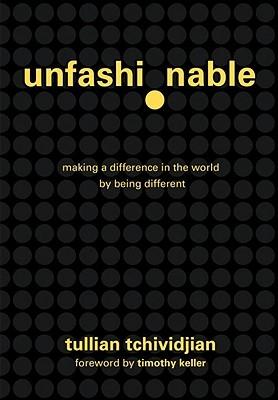
“Unfashionable” – Tullian Tchividjian

Christians make a difference in this world by being different from this world; they don’t make a difference by being the same.

What does it look like to live a Christian life? When people look at us, what should they see? Should Christians stand out, visible against a backdrop of non-believers? Should they have that subtle, “there’s something different about you” quality that is recognizable but not necessarily dramatic? Should we blend in entirely, like some kind of special forces undercover God Squad?

A little over 100 years ago, a debate raged in the church about truth. Was the Bible completely true, how does what the Bible says interface with the world around us, and what should Christians believe? This was sparked by a book that has impacted Christianity more than almost any other book ever written – “On the Origin of Species” by Charles Darwin. Because ofDarwin’s hypothesis of evolution, Christians around the world brought the Bible’s creation account into question, which brings the entire Bible into question. The debate raged – do Christians believe in the Bible and look like fools to a world that was increasingly drawn to scientific studies or do Christians change their views of what the Bible, God’s revelation, and truth really are? A battle raged for several decades between what would be known as Fundamentalists and Liberals within the church, eventually leading to the distancing of more liberal denominations, including many Methodists and Presbyterians, as well as a significant theological shift in many major Christian seminaries and schools, most notably Princeton Theological Seminary.

The debate between Fundamentalist Christianity and Liberal Christianity, much like the debate between evolutionary biology and intelligent design, is far from over. However it could be said that for 100 years fundamentalism has been losing the fight. With the loss of Princeton(that really was a big deal), among other events, fundamentalists retreated in the culture war and holed up in big, closed off buildings away from the front lines.  Take a look at a lot of buildings built by conservative churches from the early- to mid-20th century and you will see big, imposing walls with very small windows that feels closed off from the outside.

One of my soap boxes for years has been that conservative Christians need to be engaging culture more and fulfilling our calling to love and care about others. Too often we have looked down at “sinners” like homosexuals, people who have children out of wedlock, alcoholics, smokers, etc., and we have very effectively hated both the sin and the sinner. We cannot and should not accept these sins, but these sinners should be loved and cared for by our churches just like the sinners that are volunteering in the ministries, serving on the church boards, and preaching the sermons.

When I started reading “Unfashionable” I was worried that I was going to get another book that said we need to separate from the world more. I’ve read too many of those and heard that too often already. However, that isn’t the message Tchividjian has. The subtitle of the book really is his focus; “making a difference in the world by being different.”

The Bible makes it clear that Christians need to be people of double listening – listening to both the questions of the world and the answers of the Word. We’re responsible to be good interpreters not only of Scripture but also of culture.

Christians aren’t called to simply wait out our time on earth until we can get out of here – we are called to a purpose, right here and right now. We have lives to live, people to serve, work to do. Being “unfashionable” as Tchividjian outlines it isn’t about running away, it’s about standing up. We are called not to conform but to transform; our lives should reflect Truth like a city on a hill, so that we shine Truth into the dark world that we are living in.

None of this means that following and applying God’s Truth to our lives is easy. “Unfashionable” is a challenging book to help us keep our focus in the right place. Our lives should not be structured around the world’s assumptions and forms; they should reflect God’s priorities for us. We should not be living passive, scared lives; we should be boldly proclaiming God’s truth, even as we humbly admit we are still trying to understand it.

To us [God] has given – and will continue to give – grace and truth. And it’s grace enough and truth enough that we’ll become people who make a profound difference in this world…by being profoundly different from this world.

“Unfashionable” by Tullian Tchividjian

ISBN# 1601420854

“Weird” – Craig Groeschel

Normal infects our faith as well, both what we believe and how we live it out. When we consider how people relate to God, it’s normal to either reject God altogether or believe in him while living as if he doesn’t exist. In churches, normal is lukewarm Christianity, self-centered spiritual consumerism, and shallow, me-driven faith. God has become a means to an end, a tool in our toolbox to accomplish what we want. The majority of people claim to know God, but by their actions they deny him.

And all this is normal.

But normal isn’t working.

As I have discussed contemporary challenges for the church with various people, a lot of current struggles come up: homosexuality, the decline of sexual values, a reduced view of the Bible as God’s word, the exodus of young people from churches, a lack of spiritual depth, etc. The list of things churches and Christians are struggling with really could go on and on. However, there is one issue that I believe is the primary struggle that accounts for most of these second-level issues. That issue is laziness.

You could also call it apathy or as Groeschel terms it, being normal. It is this rampant tendency to follow the crowd and avoid challenging anyone (most of all yourself), and to fall in line with what is comfortable and familiar. The tough reality is that we are called to something radically different, something weird. We are not told to conform, but to follow a unique path laid out by God.

Groeschel points out the struggles that go with being “normal”; stress, anxiety, depression, shame, a feeling of being lost or alone. Our world is struggling because of “normal” and, as Christians, we have been given a cure for those struggles, but it comes with a dramatically different lifestyle. In the book, Groeschel talks about how our time, our finances, our relationships, our view of sex, and our personal values should reflect God’s kind of weird, and how as Christians we should stand out from the world.

This book is a great challenge to Christians who have gotten lazy. We all tend to fall into patterns, and we often do things to avoid rocking the boat. However, being a Christian should be hard. If being a Christian for you is easy, then you are doing something wrong. When we are living as Christ has called us to live, then we are very different from the world around us. In their eyes, we’re weird. But that is what God has called us to and what we must do in order to follow Him.

If you have just enough of Christ to satisfy you but not enough to change you, answer his knock and let him make himself at home with you.

You’ve purposefully chosen to leave the broad path. You’re gladly traveling the narrow road. Your journey may seem weird to others, but your destination will be infinitely better than anything a settle-for-normal world can offer.

Because you can’t settle for normal any longer. You can’t be normal, because you are getting to know the loving, grace-filled, all-powerful God of the universe. And as you come to know him, you’re becoming like him. The more you are like him, the more different you will be.

Weird.

“Weird” by Craig Groeschel

ISBN# 0310327903

Words, words, words

I have always enjoyed reading. When I was a kid, I read all kinds of things, from some terrible Sci-Fi novels to Shakespeare (the title is a Hamlet quote, by the way; Act 2 Scene 2). What I haven’t always enjoyed was reading books that would teach me something. Especially after college, I found it really difficult to pick up any books other than those that would be entertaining or distracting.

A lesson I learned from many older and wiser teachers was this: when we stop reading, we stop learning and growing, and we will never reach the potential God has put in us. So I started reading again, and slowly a desire to continue to read and learn has grown. Recently I put together about a 10 month list of nonfiction books I have read, and it was exciting for me to look back at what God has taught me in that time.

Reading isn’t just about the words, it is a time investment. When you read something for the purpose of learning and personal growth, you are investing time in yourself.  So not only is reading important, reading the right books are important. Every book I pick up and read I have chosen for a very specific reason; a specific topic, a specific author, maybe a recommendation from someone I trust. I have intentionally spread out the material I have read; books published in the last couple of months, books by the early church fathers, leadership teaching, discipleship teaching, history, contemporary issues, etc.

I want to share some of this with anyone interested in investing in themselves. I will be writing posts on some of the books I have been reading. I will compile a list of these posts under the section “Recommended Books.” I hope you read some of these and share your thoughts. Remember, knowledge that isn’t shared is useless.

“How Do You Kill 11 Million People?” – Andy Andrews

The answer is breathtakingly simple. And it is a method still being used by some elected leaders to achieve various goals today. How Do You Kill 11 Million People? Lie to them.

The holocaust is universally viewed as an absolutely horrible event. We have pictures and movies documenting the atrocities carried out by the Nazi’s and we have museums remembering those who were persecuted during that time. I have been to the United States Holocaust Memorial Museum in Washington DC twice now, and I will never forget what was shown there. However, in all that is said about this well documented historical event, how often is the question of how 11 million people were so easily controlled asked?

In the very short book, “How Do You Kill 11 Million People?” Andy Andrews points to several steps along the path where the Nazi leadership manipulated those they were seeking to exterminate, keeping them in the dark until it was too late for them to fight back. Andrews uses this history lesson to warn us of the consequences of blindly following what we are told.

It is a lesson we all need to hear. Too often we settle for what we are told by others; we fall in party lines, we assume whatever the media or the politicians or the preacher up front tells us, and we do not take time to think for ourselves. I am a pastor, and I teach teenagers, but I often remind them that it is not by job or my desire to tell them what to think; they have to seek out truth themselves. If they are convinced that the Bible says something contrary to what I am telling them, then by all means they must follow the Bible!

This sounds simple enough, but how often do we listen to others with a critical ear, and how often are we willing to stand up for what we believe despite opposition or, more radically, seek out answers to something we have heard but aren’t sure of? A little while ago I was asked by someone to evaluate a sermon that this person and I had sat through. I said that, while it was not one of those life-altering, “I’ll never be the same!” sermons, it was pretty good. The follow up question was, “Did you disagree with anything that was said?” My response was, “Of course I did!”

How often do you listen to anyone talk for 30 or 40 minutes and not disagree with anything that he other person said? While I appreciated the sermon, and while the pastor and I were and continue to be friends, we do not agree 100% on every aspect of theology. However, those minor differences do not prevent me from learning anything from his teaching; they can actually enhance the message because they cause us to think about what is being said, and they can help us to better understand what we believe.

Do you think this way, do you take time to critically consider what is being said, or have you fallen into the trap of simply accepting whatever a certain person or group of people have told you? Sometimes people are wrong, and sometimes people intentionally lie in order to manipulate others. Don’t be lazy – think for yourself, and stand for what you believe!

 Why do the ages of our world’s greatest civilizations average around two hundred years?

Why do these civilizations all seem to follow the same identifiable sequence – from bondage to spiritual faith, from spiritual faith to courage, from courage to liberty, from liberty to abundance, from abundance to complacency, from complacency to apathy, from apathy to dependence, and finally from dependence back into bondage?

“How Do You Kill 11 Million People?”, by Andy Andrews

ISBN# 978-0-8499-4835-0